


Crafting Gripping Narratives: Who, What, Where, When, Why, & How
Part Three
In Parts One & Two, we’ve explored the critical elements of storytelling:Who—The Eye, When—The Clock, and How—The Blueprint. Now it’s time to set the stage with the writer’s tools for creating tension, building emotional depth, and crafting captivating settings with What, Why, andWhere.

*Affiliate links are used in this article. The Mystery Review Crew is an Amazon Affiliate and, as such, earns from qualifying purchases. See our privacy policy and disclosures for more information.
WHAT—The Spellbook
This is where storytelling becomes electric. What keeps readers hooked, invested, and turning the pages long after they meant to stop? Let’s open the writer’s spellbook, their bag of tricks, and find out.
Even the word spellbook is intriguing, conjuring images of magic. For the writer, it represents the elements of suspense—hooks, red herrings, foreshadowing, and cliffhangers. The moments that pull a reader deep into the plot, with that irresistible feeling—I just had to keep reading.
The Hook
This is what grabs a reader by the collar, the opening line of the first chapter—the gateway to the story. It’s the first impression, the one that either seizes the reader or lets them slip away. But a hook is more than just a flashy sentence. It sets expectations, sparks curiosity, and signals the kind of journey the reader is about to take.
While a hook is often the first sentence, it doesn’t have to be. Some openings unfold over several sentences, building tension, layering emotion, or sharpening intrigue before delivering the moment that truly locks the reader in.
A powerful hook can take many forms. It might open with action, plunging the reader into an intense moment:
His heart raced, and lungs heaved as he gulped in air. Or it can lean into mystery, hinting at danger or secrets: The black‑clad woman melded into the shadows cast by a line of idle railroad cars and diesel engines.
Some hooks strike through emotion, pulling the reader straight into a character’s internal world: Something was wrong, terribly wrong. Others rely on an unexpected fact that snaps the reader to attention: He hated undercover assignments. Whatever form it takes, a hook succeeds because it sparks a question the reader must answer.
Red Herrings
In mysteries, red herrings work much like the misdirection in the classic board game Clue. Players follow a trail of clues, eliminate suspects, and chase leads that may or may not point to the real culprit. Was it Colonel Mustard in the library with the candlestick, or Miss Scarlett in the dining room with the lead pipe? The uncertainty is the point. That same strategic misdirection is at the heart of red herrings in storytelling.
Red herrings are the ultimate sleight of hand in a plot. They lure readers down the wrong path, make them second-guess everything, and keep the tension razor-sharp. By planting false leads, writers can divert attention from the true twist or solution, making the outcome more challenging to predict and far more satisfying when revealed. They often lead to reader reactions like, Didn’t see that one coming, or I picked the wrong guy.
And they aren’t just tricks—they’re tools. Used skillfully, red herrings add texture to the narrative, making the plot more unpredictable and riveting. They shape the reader’s expectations, sharpen the mystery, and make the final reveal land with a resounding impact.
Writers thrive on this dance of misdirection. A well‑placed false lead convinces the reader they’re onto something, only for the truth to blindside them at the last moment. Whether it’s a shifty character who seems guilty but isn’t, a clue that turns out to be meaningless, or a motive that looks sinister but is entirely innocent, red herrings add layers of mystery and unpredictability. They make a story feel like a puzzle—one the reader is determined to solve, only to discover they’ve been expertly led astray.
Red herrings transform a mystery into an experience—one where every assumption is suspect.
Foreshadowing
Another technique writers rely on is foreshadowing—the subtle hint at what’s to come without giving too much away. It’s the art of planting clues about future events, character choices, or emotional turns long before they unfold. Done well, foreshadowing creates a sense of inevitability, making the final reveal feel both surprising and perfectly earned.
Foreshadowing works because it builds anticipation. Readers may not consciously register every detail, but their instincts do. A seemingly throwaway comment, an odd detail in the background, a moment of hesitation—these small signals create a quiet tension that hums beneath the surface. When the truth finally emerges, the reader feels that jolt of recognition — that instinctive, almost breathless, How did I miss it?
Foreshadowing comes in several modes, each shaping the reader’s expectations differently.
Direct Foreshadowing: A clear hint that something is coming.
“A light tinkle of metal alerted her. Ahead, shadows at the edge of a building shifted.”
Indirect Foreshadowing: Subtle clues woven into dialogue, setting, or a character’s behavior.
Her gaze darted across the lot and sidewalks, scanning cars and faces for anything amiss. Everything appeared normal, but the unease clung to her, heavy and insistent.
Red Herring Foreshadowing: A clue that looks important but leads the reader in the wrong direction, sharpening the mystery.
In the shadows, hidden and still, someone waited. When she turned the corner, a black truck rolled forward, quiet and deliberate, blending with the darkness, a hunter closing in on its target.
At its core, foreshadowing is about building a mystery. It plants questions in the reader’s mind, hints at danger or revelation, and creates the sense that every detail might matter. These subtle signals weave a thread of anticipation through the narrative, deepening suspense and sharpening curiosity.
Cliffhangers
What creates that delicious sense of anxiety and suspense? What keeps us reading far into the night as we whisper, just one more chapter? You reach the end of the page, and there it is—the cliffhanger. The zinger. The moment that forces you to keep going because you have to know what happens next.
Cliffhangers are one of the most powerful tools for keeping readers hooked. Whether through ongoing action, emotional revelations, or sudden twists, a well-written cliffhanger adds momentum and intrigue. And there are many ways to use them.
Foreshadowing builds intrigue within a chapter, but when used at the end of one, it becomes downright riveting—leaving readers on edge and eager for what’s next. The memory of his words sent another chill skittering down her spine.
Even a dog can deliver a cliffhanger. He barked again before slipping into his deep growl.
Some cliffhangers leave something unresolved—an unanswered question, an incomplete action, or a revelation that shifts the stakes. What did the ATF agent say, maybe ten detonators? So, where’s the rest of them?
A twist at the end of a chapter forces the reader to reevaluate everything they thought they knew. It was impossible, but it was there—a message from the dead.
Cutting off at a climactic moment compels the reader to seek resolution. They could remain behind cover and pick her off. With the wall of the garage behind her, she had nowhere to go.
And it’s not just action. Deep emotional moments can be just as gripping. Is this what it feels like to die?
Cliffhangers keep the story pulsing forward, tightening the tension with every chapter break. But suspense alone isn’t enough. To truly grip a reader, a story needs emotional resonance—the heartbeat beneath the action. That’s where we turn next.
WHY —The Engine
Why does a story work? Why does it become intriguing and captivating? Why does it reel in a reader and not let go? It’s because the characters, the heartbeat of the story, come alive. Their reactions, emotions, and feelings are the engine that propels the plot forward and pulls readers deep into the narrative.
Every moment on the page is shaped by how a character responds to what they see, hear, and feel. Some reactions are instinctive—a flinch, a breath caught in the throat, a tightening of the jaw. Others are conscious choices shaped by memory, belief, or desire.
Reactions don’t stay internal. They manifest in body language, facial expressions, and tone of voice. This is where subtext comes alive. Subtext is the meaning beneath the surface, what the reader senses even when the character says nothing at all.
Instead of stating that a character is nervous, a writer can show it through quick, shallow breaths, fingers twitching against fabric, or darting eyes that refuse to settle. A smile becomes lips twitching at the edges, never fully curving. A clenched jaw suppresses anger; trembling fingers betray fear.
These techniques pull the reader into the scene, making the character’s reactions tangible rather than simply stated. The man’s expression froze. His eyes darted over her shoulder, his body stiffening.
Unconsciously, she rubbed the goosebumps rising along her arms while her eyes scanned the thinning crowd.
Characters don’t just exist in a space—they react to it. Their movements, hesitations, and sensory experiences deepen mood, tension, and realism. Embedded in the hard ground, the sharp edges of rocks dug into her thighs as she inched forward. Stalks of weeds, impatiently thrust aside by a brush of her hand, tickled her nose.
The momentum of a story is powered by a character’s reactions — fear, hope, longing, suspicion, desire, danger. And the more vividly those reactions are grounded in the world around the character, the more deeply the reader feels each moment.
Where—The Landscape
Settings aren’t just backdrop—they’re an active force that shapes mood, tension, and meaning. Whether it’s a house, police station, bar, small town, grocery store, or parking lot, the where of storytelling influences how characters interact, how tension builds, how emotions unfold, and how the story moves forward.
A well-crafted setting makes a scene feel authentic, allowing readers to experience it as if they were there. The way light filters through dusty windows, the scent of rain-soaked pavement, the sour odor of garbage in an alley—these details create a sense of place that feels natural and believable. Even shifting shadows or the creak of a chair as someone shifts uncomfortably can reinforce the moment’s realism.
Setting as a Character
A powerful setting doesn’t sit quietly in the background—it behaves. A storm rolling in, a deserted street at midnight, a cramped interrogation room, a remote ranch road with no cell signal—each one exerts pressure on the characters, shaping their decisions and emotional responses. When the environment pushes back, constrains movement, or amplifies fear, it becomes an active participant in the story.
Setting as Tone and Atmosphere
Landscape establishes tone long before a character speaks or acts. A sun-bleached small town carries a different emotional charge than a rain-slick alley or a sterile government hallway. Readers absorb these cues instantly, sensing whether danger, comfort, or uncertainty lies ahead. The right setting primes the reader for the emotional beat that follows.
Setting as Plot Catalyst
Where a scene takes place can determine what’s possible. Geography, architecture, and weather can trap characters, expose them, or force them into choices they wouldn’t otherwise make. A narrow escape route, a locked gate, a crowded festival, or a darkened warehouse can shift a scene’s trajectory. When setting influences action, the story gains a sense of inevitability and realism.
Scenes as Lenses
The way a scene is described controls focus, much like a camera framing a shot. Word choice sharpens what the reader sees and how they interpret it. A scene isn’t just about what’s happening—it’s about how it feels. Sensory details—touch, sound, smell, sight, and taste—add depth and texture, pulling the reader deeper into the moment.
Scenes also convey emotion and movement. A tense confrontation might be driven by sharp, abrupt sentences that echo the intensity of the exchange. A quiet moment may stretch with lingering descriptions.
A realistic scene feels lived-in. When the layout of a room, the geography of a town, or the rhythm of a neighborhood remains coherent, the world feels trustworthy. Even small continuity details—where a door is located, how long it takes to cross a parking lot, which streets connect—anchor the reader in the story’s reality.
The Wrap-Up
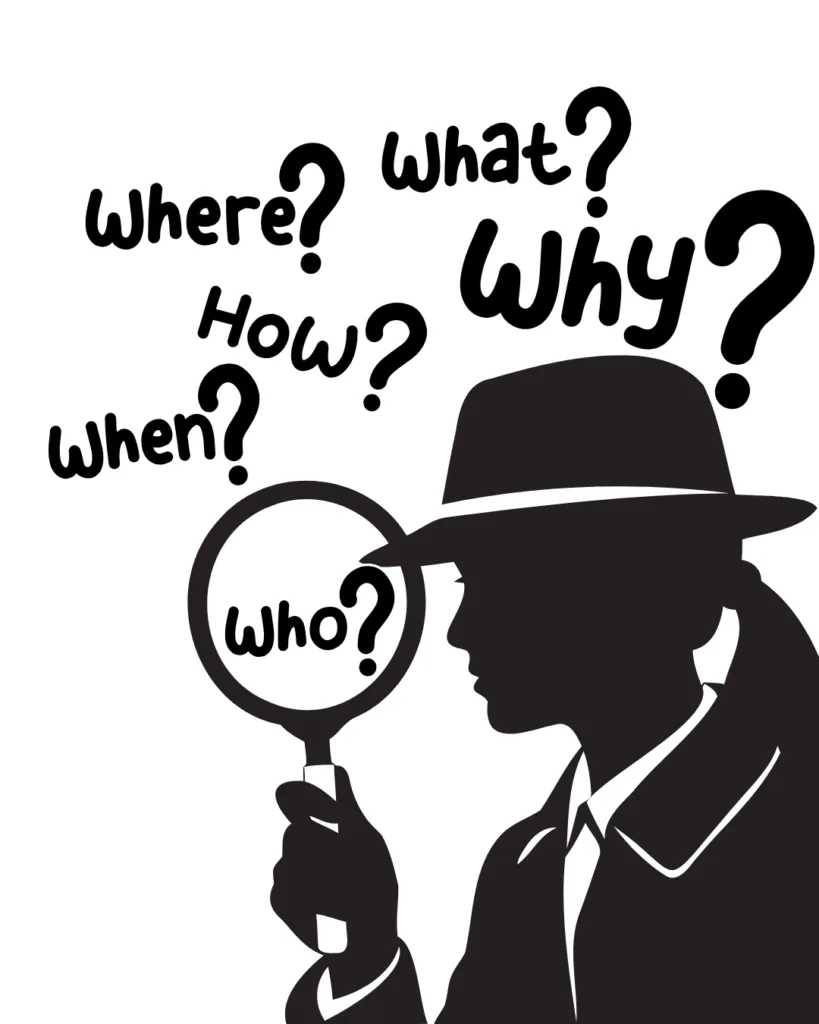
It’s funny when you think about it. These six questions, who, what, why, where, when, and how, have been around for many years. But I’m not sure anyone has ever stopped to look at them through a storyteller’s lens. We’ve always treated them as tools for solving crimes, not crafting narratives.
But when you reimagine them from the standpoint of writing, something clicks. Who, What, Why, Where, When, and How stop being cold investigative prompts and start becoming the bones of a captivating and intriguing story. Six old questions. A completely new way to use them. And all the ingredients a writer needs to craft a story that pulls readers in and doesn’t let go.
Excerpts were drawn from the following novels by Anita Dickason
Murder with Wine, A Tori Winters Mystery




Your articles are a great….Keep you the good work.