Spells, Spirits & Spooky Pages: The Grimoire Lore
As the nights grow longer and the air turns crisp, something shifts. It’s the season of flickering jack-o’-lanterns, whispered legends, and the thrill of the unknown. October has a way of stirring up old stories. Spooky rituals. The kind of magic that lingers just beneath the surface.
It’s the time of year when witches ride—at least in our imaginations. We curl up with ghost stories and decorate our homes with skeletons, black cats, and spellbound curios.
There’s no better time than October to unlock the mystery of—GRIMOIRES! Even the name seems to echo with eerie vibrance. Not surprising since the grimoire is an arcane manual of spells, rituals, incantations, and instructions for summoning spirits or crafting magical tools. A book that doesn’t just inform, it conjures.
Grimoires have long haunted the edges of history and imagination. They’re not viewed as mere books, but as gateways. Portals that cross the shadowy line between reality and magic. Some would say beware! Once opened, they rarely stay silent.
Nor are they just dusty old books tucked away in a witch’s cabinet, though that is an enthralling image. Grimoires offer a fascinating glimpse into how people have tried to understand—and influence—the world around them. Long before they trended on TikTok or appeared on Amazon, they were serious business. Sacred. Often forbidding. Always mystifying.
So, settle back. Grab a cup of your favorite brew. The Mystery Review Crew explores the intriguing world of grimoires, where things are about to get enchantingly weird.

ORIGIN
The word grimoire traces back to the French word grammaire. In medieval Europe, it was a broad term for scholarly texts. But by the 18th century, the word had transformed. Grimoire now meant books devoted to magic.
Yet the roots of the grimoire reach much further back. Long before the word existed, ancient cultures were recording mystical practices. Egyptian scrolls brimmed with spells and protective incantations. Babylonian clay tablets mapped omens and astrological signs. Roman manuscripts provided instructions for summoning gods and spirits, blending mysticism with medicine.
During the Middle Ages, the tone of the texts changed, becoming dangerous, even heretical. Monks and scholars mingled Christian mysticism with arcane pagan rites. The manuscripts offered detailed instructions for invoking angels, binding demons, and crafting talismans. Possessing one could lead to excommunication … or worse.
Driven underground by medieval persecution, the manuscripts, later known as grimoires, began to emerge during the Renaissance era. They spread across borders and languages. The print press accelerated their spread, and suddenly, grimoires weren’t just for cloistered scholars. The age of international magic had begun.
The Spellbooks That Shaped History
What follows is a journey through the most influential spellbooks in history. Texts that blurred the line between sacred and profane, myth and reality. And it begins with one of the most enduring.
The Key of Solomon
Son of David and Bathsheba, King Solomon reigned in ancient Israel during the 10th century B.C. For those who may not recall their history lessons, he’s famously remembered for a chilling pronouncement: to settle a child custody dispute, he proposed dividing the child with a sword. A test of true maternal love.
Though his reign was marked by peace and prosperity, Solomon’s legacy is steeped in myth and mystery. According to legend, he authored a magical book: The Key of Solomon. A blueprint for controlling spiritual forces so powerful that it was buried with him. Centuries later, the book was said to have been unearthed from his tomb. Which is how the manuscript supposedly resurfaced in medieval Europe.
Of course, historians have their doubts. Most surviving manuscripts date from the 14th to the 18th centuries, long after Solomon’s time. It’s believed the attribution was likely symbolic, meant to add authority and mystique. Even then, marketing had its magic.
The Lesser Key of Solomon
Like the Key of Solomon, this manuscript invokes the name of King Solomon. That’s where the similarity ends. While the Key of Solomon is often described as formal, marked by ritual and royal authority, its shadowed counterpart is marked by the graveyard and demons.
The 17th-century grimoire is divided into five books, the most infamous being the Goetia, a catalog of 72 demons, their sigils (magical seals used to identify and summon spiritual entities), and detailed instructions for conjuring and commanding them. It’s dark, meticulous, and has inspired everything from occult rituals to pop culture references in horror films and video games.
According to historians, the title Lesser Key of Solomon isn’t original to the manuscript. The name was likely penned in the late 1800s to distinguish it from the Key of Solomon. The attribution added mystique, and perhaps a touch of marketing flair, to a book already steeped in shadow.
The Book of Abramelin
Some say this grimoire is more captivating than The Key of Solomon. Less a manual, more a mystical travel diary. It promises not just magical tricks, but a path to true spiritual transformation.
According to the text, it’s the autobiographical account of Abraham of Worms, a German Jewish scholar who traveled to Egypt in the 15th century. There, he encountered Abramelin, a master of divine magic who imparted a formidable system of spiritual knowledge. The teaching emphasized purity, devotion, and the pursuit of one’s Holy Guardian Angel. A concept that would echo through later occult traditions.
Yet, like many grimoires, the actual authorship is uncertain. Some scholars have speculated that the manuscript may have been written by Rabbi Yaakov Moelin (Maharil), a renowned rabbinic figure of the same era. This theory, however, is contested and unconfirmed. Whether Abraham was a real historical figure or a literary fabrication, it’s claimed that the book’s mystique is amplified by its elusive origins.
The Picatrix
This was an interesting search. Various descriptions abound, everything from a chaotic mix of astrology and talismanic magic to the go-to source for Renaissance magicians to discover planetary power and celestial secrets.
Composed sometime between the 10th and 11th centuries, the text became a cornerstone of Renaissance magic. Evidently, its influence runs deep. It’s reported that anyone who’s ever dabbled in planetary magic has likely felt its ripple.
The Grand Grimoire (aka Le Dragon Rouge)
Said to have been written in the 16th or 18th century (depending on which historian is asked), The Grand Grimoire is infamous for its bold claims: summoning Lucifer himself and forging pacts with demons.
Often labeled a “black magic” text, it’s riddled with ritual instructions and occult lore. Some versions have been linked to Haitian voodoo traditions. Le Dragon Rouge is often cited by historians and occult scholars as one of the most notorious grimoires in occult history.
The Grimoire Effect: From Lore to Lifestyle
Grimoires aren’t just ancient artifacts. They’ve become part of the fictional backdrop for paranormal fantasy and suspense, appearing in movies, TV shows, and books. The moment a character pulls out a leather-bound tome with strange symbols, things are about to get weird. Grimoires have starred in countless films and shows, often as the key to unlocking supernatural chaos—or saving the day. Either way, they’re central to the story’s tension.
From Hocus Pocus and Charmed to Buffy the Vampire Slayer and The Witcher, magical texts guide heroes through curses, rituals, and monster-slaying adventures.
Every October, grimoires become part of the seasonal settings. They can be found as props in haunted houses, Halloween store displays, and DIY spellbook crafts. They’re often paired with bubbling cauldrons, broomsticks, and black cats—symbols that trace back to centuries of folklore and fear.
And it’s more than decoration. The image of a witch with her grimoire taps into something more profound: the idea of hidden knowledge, personal power, and a connection to forces beyond the everyday. It’s no surprise that people feel drawn to the concept of keeping their own magical journal, even if it’s just for fun.
Today, grimoires are as diverse as the individuals who keep them. Thanks to social media, they’ve gone from spooky props to lifestyle inspiration. They can be handwritten journals, digital files, or even private blogs.
But whether ancient or modern, one element remains the same: grimoires are where magic lives on the page.
Some Grimoire Reading Recommendations
The Grimoire Girls: Paranormal Women’s Fiction with a Twist of Mystery and Motherhood (Midlife Magic in Moondip Book 1)
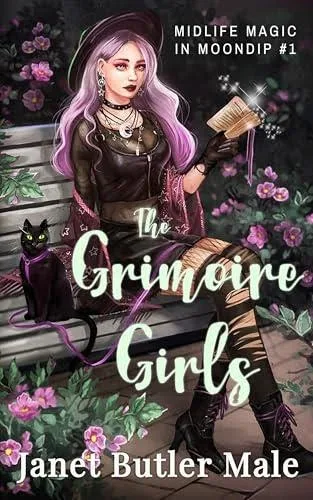
Author: Janet Butler Male
Genre: Mystery, Paranormal
Series: Midlife Magic in Moondip #1
Magic got them into this mess. Now it’s their only way out…
Layney’s life looks picture-perfect—respectable husband, sweet teenage daughter, and a five-bedroom home in Cheshire. But when her daughter acts possessed and long-buried memories resurface, Layney realises something is very wrong.
Years ago, Gran cast a spell to keep them safe. Now it’s wearing off.
When Layney remembers her long-lost Highland heartthrob, one blazing row with her husband is all it takes to set her escape plan in motion. She’s heading to the wilds of Scotland—specifically, the remote Isle of Whye, where Gran once lived.
But just before she arrives, shocking news reaches her: Gran has died… and left her a timeworn bookshop, with cosy living quarters above, nestled in a tucked-away village that doesn’t appear on most maps.
Also left behind? A murder. And Layney might be the next victim.
With the help of a snarky talking cat, Layney must unlock her true power, solve the mystery, and decide if she’s ready to risk her heart again—preferably with a rugged man in a kilt.
The Grimoire Girls is a warm, witty mystery packed with second chances, magical mayhem, and midlife reinvention.
On Goodreads, Amazon, and Bookbub.
The Shakespearean Spellbook: A Cozy Literary Mystery of Hidden Spells, Secret Societies, and a Magical Librarian (The Enchanted Tome Mysteries Series Book 1)

Author: Liora Dawn
Genre: Cozy Mystery, Paranormal
Series: The Enchanted Tome Mystery Series Book #1
In the quiet town of Willowbrook, secrets don’t stay shelved for long…
When Eleanor Hart, a warmhearted librarian with a curious streak, discovers a missing Shakespeare folio in the historic Willowbrook Library, she stumbles into more than a rare book mystery. The folio hums with strange energy—and it’s just the beginning.
After a wealthy collector is found murdered, Eleanor suspects a dark connection between the stolen manuscript and a centuries-old secret society obsessed with forbidden knowledge. As whispers of alchemy and arcane symbols surface, she joins forces with a skeptical historian and her ever-watchful cat to uncover the truth.
What they find hidden between the lines is more than just ancient text—it’s magic bound in ink and parchment, and someone will kill to unleash its power.
Full of twisty clues, hidden histories, and magical realism, this first-in-series cozy mystery blends literary lore and enchanting suspense for fans of Ellery Adams, Gigi Pandian, and Alice Hoffman.
The Cat Stole Your Tome: A paranormal cozy fantasy mystery (Ghastly Grimoire Mysteries Book 1)

Author: Jeannie Wycherley
Genre: Fantasy, Paranormal, Cozy Mystery
Series: Ghastly Grimoire Mysteries Book #1
Without Zilla, there’d be no witches zooming around on their broomsticks and nobody would be allowed an exotic animal as a familiar. She grants permits for a living. Okay, it’s not riveting stuff but it’s important.
The day a cute but pushy pussycat arrives at her apartment complex, so does a grotty old journal full of blank pages. Until now Zilla has enjoyed a simple life: her clean, quiet apartment; a couple of potted plants that she struggles to keep alive. She’s not an exceptional woman. She doesn’t have many friends. She’s never owned a pet … and she most certainly does not want a cat.
But now her life is upended. Responding to her touch, the ragged journal slowly offers up its contents, revealing an ancient grimoire full of secrets … including the historic murder of a young boy.
Determined to reunite the grimoire—and the cat—with their rightful owner, Zilla begins investigating but it isn’t long before she ruffles a few feathers and finds herself in grave danger. Can she awaken hidden traits from deep within herself. Resilience? Curiosity? Courage?
Because, in order to survive longer than her pot plants, she’s going to need all of those and more!
On Goodreads, Amazon, and Bookbub.
Grimoires and Gingerbread: A Sugar Shack Witch Mystery Christmas Novella (Sugar Shack Witch Mysteries Book 2)
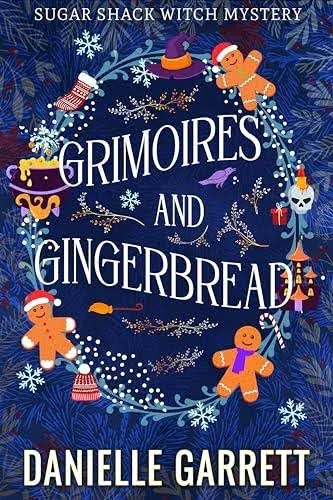
Author: Danielle Garrett
Genre: Cozy Mystery, Paranormal
Series: Sugar Shack Witch Mysteries Series Book #2
Christmas in Winterspell means ice skating, hot cocoa by the barrel, and frosted gingerbread houses. I was almost looking forward to it. The merriment screeches to a halt when two elves show up, claiming to have been sent by Santa himself, on a mission to track down an ancient grimoire. A grimoire with the power of Christmas itself woven through the pages. Without it, Christmas isn’t happening, and Santa himself is in grave danger. Could Winterspell hold the key to saving Christmas?
**Grimoires and Gingerbread is a holiday-themed novella in the Sugar Shack Witch Mysteries series by Danielle Garrett. This festive novella falls after the events in the first book, but could also be enjoyed as a standalone.**
On Goodreads, Amazon, and Bookbub.
Be sure to check out more of our October-themed fun 🙂