This month, for our cozy kitchen mystery theme, we’re interrogating… we mean interviewing Cozy Culinary Mystery Author Amber Royer! Amber Royer is a fellow Texan and a Chocolate fanatic, too!
About Amber Royer
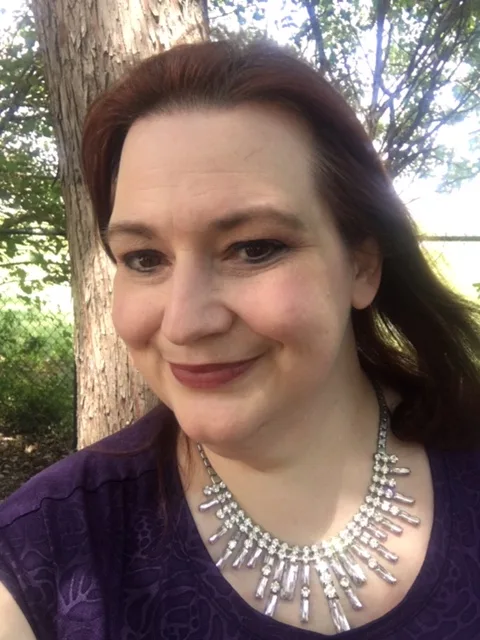
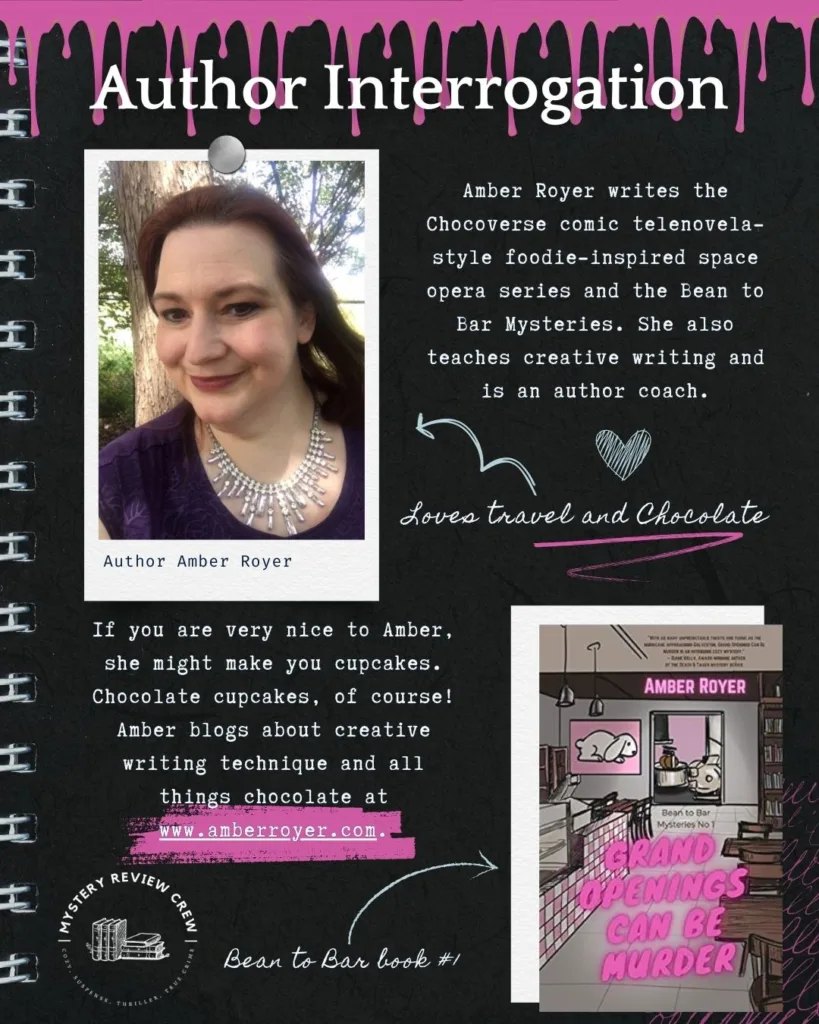
Amber Royer writes the Chocoverse comic telenovela-style foodie-inspired space opera series and the Bean to Bar Mysteries. She also teaches creative writing and is an author coach. Her workbook/textbook Story Like a Journalist and her Thoughtful Journal series allow her to connect with writers.
Amber and her husband live in the DFW Area, where you can often find them at local coffee shops or taking photographs of landscapes, architecture, and wildlife.
They both love to travel, and Amber records her adventures on Instagram – along with pics of her pair of tuxedo cats.
If you are very nice to Amber, she might make you cupcakes. Chocolate cupcakes, of course! Amber blogs about creative writing technique and all things chocolate at www.amberroyer.com.
Our interrogation… I mean, Interview with Author Amber Royer
*Affiliate links are used in this article. The Mystery Review Crew is an Amazon Affiliate and, as such, earns from qualifying purchases. See our privacy policy and disclosures for more information.
Kimberly here, this month we’re going full-on cozy food-related mysteries, and I just had to introduce you to Amber Royer! I’ve known Amber Royer and worked with her since her first Beans to Bar mystery came out (though she doesn’t know me). She’s a true Chocolate Connoisseur, and it shines through in her books and her detailed research!
Hi Kimberly! Thanks for taking the time to interview me. I love the questions you asked.
You’re being tailed through a crowded Texas farmers’ market—who do you call first: your main character, a chocolatier, or a best friend gone rogue? Justify your answer.
I’m calling my protagonist. Felicity has come a long way since the first book in the series, where she and her BFF Autumn attempted to tail a suspect while driving a catering van, with hilarious results. She could definitely help me slip out of sight while a couple of the other characters from the series – including former cop Logan, current cop Arlo, and Logan’s also-a-cop sister Dawn – could find out more about the situation. If that failed, Felicity could at least call podcaster Ash (who starts the first book as Felicity’s nemesis, after he writes an article that implies she actually committed the murder that happens at Greetings and Felicitations in Grand Openings Can Be Murder. Though Ash is blunt and can be annoying, he’s actually saved Felicity’s life a couple of times, and he kind of grows on her. And hopefully the reader.
Fee herself has stood up to a number of bad guys. (You know, at least one per book, and I’m currently working on Book 9 in the series.) They’ve all been quite dangerous. She tends to use items that are at hand to create distractions or incapacitate baddies. If worst comes to worst, I think she would have a better chance of defending me than any of the chocolatiers I know, as amazing as they are at what they do.
Some of the craft chocolate makers I know (chocolate makers actually start with cacao beans and make chocolate, chocolatiers make chocolate into sweet treats and edible art) routinely travel to origin, visiting farms in the remote areas where cacao trees grow (predominantly South America and Africa). They know their way around a dugout canoe in the Amazon or an unpaved road in Ecuador. And they’re known for being resourceful and creative, as they basically invented the machines needed for their craft from scratch.
I’ve met chocolate makers who had former careers as engineers, archaeologists, and bakers. Jael from French Broad Chocolate drove a school bus from Minnesota to South America to learn how to make chocolate because everything else she used at her bakery was made from scratch, and she wanted to make the chocolate, too. Arcelia from Mission Chocolate set up shop in Brazil, to highlight native Brazilian fruits in her chocolate bars. Felicity is inspired by these real-world chocolate makers. I could call on one of these chocolate makers – but Felicity has the best qualities of all of them.
If your antagonist from Grand Openings Can Be Murder hosted a TED Talk, what would the title be, and what would you absolutely not want your readers to take away from it?
It would be called The Healing Power of Murder. My antagonist would start the TED Talk discussing views of human nature and the value of human life, and would point out that some people only seem to exist to hurt others and that the overall sum of pain in the universe would be less without those people in it. I hope this character’s audience would not take away the idea that the ends justify the means, and that even innocent people can be killed if they get in the way of a greater sense of purpose. (As they are mathematically insignificant in the face of the greater good.)
The first book in the series is probably the most straightforward motive-wise. As Felicity has grown as a detective, the cases have become more complicated, as have the antagonists.
You’re locked in a chocolate factory overnight. What three fictional characters (not your own) would you want with you, and which one do you suspect will crack under pressure?
My crew would be Hercule Poirot, Sean Spencer from Psych, and Thomas Magnum from Magnum P.I. (Although Sean would probably bring Gus, making it four characters, which would make it awkward if they couldn’t all stay, because you know Gus isn’t leaving quietly.) I was going to say that I DIDN’T want Jessica Fletcher, because everywhere in town she goes, there’s a murder – but I guess that’s pretty much true with these guys too. Which means the question really is with whom and under what circumstances do I want to investigate.
The reason I would want Sean and Gus there is because in Psych, innocent characters don’t usually die, unless they are somehow threatening or irritating the bad guy. Which means I would have a pretty good chance of surviving the night. The biggest challenge for my comedic duo would be restraining themselves from eating until they are sick, given they are being surrounded by so much high-quality chocolate. You remember what happened at the Cinnamon Festival. And the Clue episode, where they found all the candy.
The character who would crack would obviously be Gus. I mean, should it come to light that the victim had potentially died from poisoned chocolate, Gus would have a freak out about being poisoned too and run around trying to find a way out of the building, only to be fine later on. But Sean’s keen sense of observation would surely come in handy when solving the case.
I’d want Poirot there for his logical thinking ability – and also his fastidious foodie nature. If there’s a mystery inside a chocolate factory, something about the chocolate is bound to be important, and Poirot would be the one to notice. (Of course, being Belgian, he’s probably used to the different flavor profiles in fine Belgian chocolate, so I might actually get to introduce him to something new.)
Think about how food plays a role in “Thirteen at Dinner” or “Mrs. McGinty’s Dead.” Or, to be a little on the nose, “The Chocolate Box,” where Poirot tells in flashback about one of his earliest cases, and the simple way in which a box of chocolates had been poisoned. He missed an important clue, and the phrase “Chocolate Box” becomes a signal between him and Hastings that he needs to show humility. Which is why, should deduction fail, I’d want the third character.
Thomas Magnum is a character who can solve a mystery – but also keep control in an action scene. If things do go wrong in The Detectives and the Chocolate Factory, I’d want a guy like him handy to incapacitate the bad guys. (Plus, as Magnum PI is one of Sean Spencer’s favorite TV characters, to the point where he grill’s one of Gus’s girlfriends about her favorite episode. The meta implications of having Magnum show up as a real person are spectacular.)
Having this chili-dogs-and-pizza-loving detective present would also cause challenges for Poirot and probably give Magnum flashbacks to his dealings with John Higgins, the guy in charge of the estate where Magnum is staying. Their banter was one of the most entertaining things about Magnum P.I., so despite the context of being stuck solving a mystery in a potentially dangerous factory full of crushing machinery, it would probably be fun to watch.
What do you hope readers take away from your stories? Is there a particular message or feeling you aim to convey?
I think each of the protagonists I’ve written have different things to say. For instance, Bo, from my space opera series, learns a lot about self-confidence and not being overly concerned about what other people think of you. Felicity, on the other hand, is all about reinvention and connection. It feels like people are so often isolated these days, either by circumstance or by being sucked into social media (Why yes, I do have a YouTube channel and an Instagram feed I would love for you to follow. Why do you ask?) that the idea of making friends and building relationships in the community where you live and work can feel like a daunting task.
I think that’s one reason we love cozy mysteries in general. It feels like a second set of friends, a second community where we can live, especially in a long-running series. We start to look forward to cameos from our favorite characters. And we feel a sense of loss when the book is over. Until next time.
In Grand Openings Can Be Murder, Felicity has returned home to Galveston, Texas, as a recent widow. She was a physical therapist, but now she’s had too much of her own pain to deal with anyone else’s, so she decides on a complete career change and opens a bean to bar chocolate business with a microfactory and retail shop. She starts reconnecting with old friends from before she married and moved away, and the tables at Greetings and Felicitations become a gathering place for the new friends she’s made. In the first book, she feels stuck in the past, but as the series progresses, she starts to realize she can still have a future and a life she loves.
Fee, like me, has a complicated relationship with social media, which is only counterpointed by the various bloggers and YouTubers that show up in the books. Teenaged Chloe – who has a YouTube channel featuring her “reformed jerk cat” Mr. Tunaface – offers to help Felicity with her marketing. She’s played an increasingly important role in the last few books.
In Vanishing Into the 100% Dark, Felicity agrees to take Chloe along when she is invited to give a class at a chocolate festival in Tokyo, and Chloe helps introduce Felicity to a group of folks using their video format to form connections and make the world a more approachable place.
You’re given the power to erase one cliché from the mystery genre forever—but the catch is, you must replace it with a new one involving dessert. What’s your trade?
One of the oldest cliches in mystery fiction is the clunky hidden identity, where characters aren’t who they seem. They may be using a false name, or turn out to be a missing relative of someone who was wronged, or simply be mistaken for someone else. Sometimes hidden identities are written well, with enough foreshadowing that we are dumbfounded we didn’t already figure it out. Those can stay. But all poorly written characters with hidden identities will henceforth be replaced by clues with hidden identities.
Did you ever see the show, Is it Cake? Where judges had to try to tell from across the room which object was the actual object, and which was a cleverly constructed sculptural cake encased in fondant? That’s what happens. Every time, one of the clues turns out to actually be cake.
A fan sends you a coded message hidden in a chocolate bar wrapper. The last line reads, “She knows about the espresso machine.” What happens next?
I guess I have to buy her a new espresso machine. It’s not my fault that writing is fueled by good coffee and characters’ bad decisions. And in this case, apparently, my bad decisions.
But that doesn’t really justify a hidden message. So maybe the broken espresso machine revealed a key hidden inside. It’s to a safe deposit box – somewhere. I have to figure that out before she catches up to me.
How has the act of writing itself changed you as a person, if at all?
Each book I’ve written has changed me. After all, reading memorable books can change a reader’s outlook and emotions. It would be strange if I was not affected much more deeply by writing it.
I firmly believe that writers each write the stories we need to heal. There’s something we want to understand about human nature, some experience we’ve had that we want to understand, a flaw our subconsciousness is telling us we need to work on, or a deep wound we need to salve. That kind of need and search for meaning produces powerful work. Creating fiction allows us to find enough difference in the circumstances to get the distance needed from the pain to become objective about it. It is possible to write a story without finding any personal connection to the material. (I’ve been a writing instructor and author coach since 2008. I’ve seen people write with a lot of different motives.) But chasing money or trying to bend to whatever is popular rarely creates stories readers will connect to.
By that, I don’t mean the character has to be you, as a self-insert, or match you in any particular demographic. You can be young and write powerfully about someone old facing loss – as long as there has been something in your life that lets you understand what loss feels like. The circumstances are immaterial, because the raw emotion is universal. And sometimes, even if we personally haven’t experienced something, we write aspirational characters. Maybe you, as a writer, don’t feel brave. So you write a brave character, willing to swoop in and stop a bad guy, or able to engage in witty banter, or ready to drive on the Autobahn. By doing so, you model what bravery feels like.
If you’re going to write it well, you have to put yourself into the character’s mind and heart, imagining this fictional person’s physical and psychological reaction in enough detail to transport the reader there. Maybe you look in the mirror and see what your face looks like when you are imagining facing your fears, and you give some of that body language to the character. You try to decide what it feels like for this character, flying down the highway for the first time. Maybe she’s got her teeth clenched, and goose pimples are running up her arms to the back of her neck, and it’s all she can do not to close her eyes – which would mean certain disaster, so now she has a stomach too, just thinking on it.
The human brain has a terribly hard time distinguishing fiction from reality, so if you imagined that highway car chase hard enough, your brain thinks you faced that fear. (It’s irrelevant how accurately you wrote the scene, or if the events even followed the laws of physics.) Say you write a dozen scenes of this character facing adrenaline-pumping circumstances. You’re going to come away from writing the book with some new thoughts about what it means to be brave – and maybe even about what you are capable of.
It’s the same thing with character arcs. You start by giving the character a foundational backstory wound that has created a character flaw, based on a lie about reality or herself that the character believes. Events in the story test that lie, and the character arcs when she realizes the truth. I didn’t understand the power of this until I completed my first series (my space opera trilogy). It wasn’t until I got to the end of Book 3 and everything started coming together that I realized I had put Bo in the paparazzi’s sights because I was trying to understand experiences I had had on a much smaller scale. She realizes her self-worth isn’t in question just because she has haters. And I started believing more in my self-worth, too. It took me three books to realize that was a deep wound I had, too.
In the Bean to Bar Mysteries, Felicity starts the series a bit stuck. She has suffered a loss and feels there’s no moving forward. (I experienced a different kind of loss from her, personally, but the emotional core was the same.) The whole first book is her figuring out that loss doesn’t define her. While bantering with two cute guys, solving a murder, dealing with her house-flipper aunt’s pathological need to find her a boyfriend, and reconnecting with the best friend she left behind when she married and moved halfway across the country. I’m drafting the ninth book in the series, and Felicity’s outlook has certainly changed. And to a degree, so has mine. (I’m actually very excited about Death by Bloomed Chocolate. Fee has decided between her two love interests – and she’s getting married for the second time.)
In general, I think writing has made me more empathetic. I’ve really had to work to understand the viewpoint of some of the characters who have shown up in my stories. So now, even if I don’t agree with someone, I can often see what life experience has caused them to behave the way they do.
If your books were banned from every library unless you rewrote them as nonfiction cookbooks with “deadly” footnotes, what would your first chapter be titled?
From Bean to Trouble. There are companies that go beyond Bean to Bar and do Bean to Baked Goods or Bean to Truffle. It would be a chapter of truffle recipes.
Footnote: To be served at the Grand Opening Party of Greetings and Felicitations, where foul play definitely will not take place. Wink emoji. Wink emoji.😉😉
Do you prefer coffee or tea? What kinds, or specific ways, to enjoy these drinks?
How do you expect me to choose? I guess I have to say coffee, because my tagline is: Coffee. Chocolate. Creativity.
But I am a tea aficionado too. On a recent trip to Japan, I spent a whole day thrift shopping for side-handled teapots and Tokyo-style cut glass tea glasses (Edo Kiriko).
Most of the time, I take my coffee with a splash or two of soy milk. I’m fond of Kona beans, possibly because I’ve trapsed across every coffee farm on Big Island that would have me. If you get the opportunity, I highly recommend touring Makura Meadows, which is owned by the Japanese coffee company Doutor. After learning about the coffee plants and touring the tropical garden, we got to sip coffee by the infinity pool and eat fruit we had picked ourselves. And UCC Coffee (known in Japan for their canned coffee, among other products) is right next door. One of their most famous canned coffees is their Kona Gold. You can taste the coffee sourced for this, right where it is grown.
If I’m going to splurge on a sweetened coffee beverage, I tend to go for a half-sweet soy latte or a milk coffee with coffee jelly.
When it comes to hot tea, I like a robust English Breakfast, or a more astringent Earl Grey. And I’m never going to be opposed to a London Fog, which is an Earl Grey latte. In the afternoon, I’m sometimes in the mood for matcha. There’s something about taking out a whisk to prepare the tea which is calming, especially if that day had many tasks. And the floral nature of good matcha paired with mild bitterness shows just how versatile tea is.
Of course, being from Texas, we always have Lipton on hand to make iced tea. Though it’s near heresy that I drink it unsweet.
I have a signature chocolate, coffee, or tea drink for each of my books in the Book Club Resources section of my website. And there are some beverages in my Bean to Bar Mysteries Bonus Recipes.
If Felicity from Bean to Bar had to run a mystery-solving dessert showdown with only ingredients found in your real-life pantry right now, what would she make—and who would it accidentally implicate?
She could easily make a decadent chocolate cake. And the person implicated would be the local Guittard Chocolate Representative. Seriously. I’m working on a second cookbook, and I have a stash of their baking chocolate and cocoa powder, along with samples of some of their other chocolates.
But in the book’s ‘verse, she would wind up implicating her shop’s pastry chef, Carmen, who made a very similar chocolate cake as a groom’s cake when Felicity’s BFF got married (Book 6 – Something Borrowed, Something 90% Dark). Here’s the recipe: https://amberroyer.com/90-dark-bonus-recipes/#cake
My first cookbook is called There Are Herbs in My Chocolate. I co-wrote it with my husband. It started out as a pamphlet, back when we were active with the Fort Worth Herb Society. We did a couple of programs for their summer festivals, including one where we sampled hot chocolate with thyme and orange, with lavender and rose, and with chili and cinnamon. We needed a product to sell on-site, but we were ambitious enough to list it on Amazon. Once we realized how much work it needed to be a full-fledged cookbook, we let it go out of print. But after Free Chocolate was published, people started asking when we were going to re-release the cookbook, so we added and tested recipes, and voila!
I actually based Carmen’s cooking style (she takes classic pastries and desserts and uses culinary herbs and refined technique to give them a glow up.) on the recipes we create for the cookbook.
You’re the surprise guest on a cooking competition hosted by Hercule Poirot and Miss Marple. The mystery ingredient? Regret. What do you make, and which one do you suspect is sabotaging your soufflé?
Wow. I’ll be cooking badly in front of two of my favorite literary detectives.
So, this one time we had a dinner party, and I got the bright idea to do soup in a crock pot ahead of time, and let it hold its heat while we prepared the other dishes. Only – it was hot and sour soup. And by the time it got around to being served, it had turned into an aspic. It was a huge cooking fail in front of my friends. But what I regret is that I let it get to me, and make me embarrassed when nobody really cared. What I really regret is that I didn’t flip the thing over onto a cake plate and see if maybe I had invented something new.
I’d make that. Honestly, it would probably be awful, and the ones with the biggest regret would be the judges that have to taste it, which serves them right for attempting to sabotage me. If I still had my soufflé, what would I be making regret soup for?
Personally, I think it was Poirot. You see, I made it with eggs that were of very different sizes. One of them actually belonged to an emu. I could just see Hercule’s little gray cells logic-ing out a way not to be subjected to such an impropriety. But that’s okay. I have a few sabotages of my own.
Thank you SO SO much for letting us interview you this month, Amber Royer. Excited to hear you are writing MORE Bean To Bar mysteries!
Be sure to check out Amber Royer’s Grand Openings Can Be Murder below.
About Grand Openings Can Be Murder by Amber Royer

Author: Amber Royer
Genre: Cozy Mystery, Culinary Mystery
Series: Bean To Bar Mystery #1
An Idyllic Chocolate Shop. An island with dramatic weather. And a murder.
Welcome to Greetings and Felicitations! It is Felicity Koerber’s bean to bar chocolate factory/shop – and her refuge from the pain in her past. When she returned home to open it, she never imagined she’d be solving a murder – but now she will have to, to save her business’s reputation and avoid being framed as a killer.
Felicity Koerber has had a rough year. She’s moving back to Galveston Island and opening a bean to bar chocolate factory, fulfilling a dream she and her late husband, Kevin, had shared. Craft chocolate means a chance to travel the world, meeting with farmers and bringing back beans she can turn into little blocks of happiness, right close to home and family.
She thinks trouble has walked into her carefully re-built world when puddle-jump pilot Logan Hanlon shows up at her grand opening to order custom chocolates. Then one of her employees drops dead at the party, and Felicity’s one-who-got-away ex-boyfriend – who’s now a cop – thinks Felicity is a suspect. As the murder victim’s life becomes more and more of a mystery, Felicity realizes that if she’s going to clear her name in time to save her business, she might need Logan’s help. Though she’s not sure if she’s ready to let anyone into her life – even if it is to protect her from being the killer’s next victim.
For Felicity, Galveston is all about history, and a love-hate relationship with the ocean, which keeps threatening to deliver another hurricane – right into the middle of her investigation. Can she figure it out before all the clues get washed away?
Cozy mystery with a little sweet romance…and a lot of chocolate.
FIRST IN A NEW SERIES
The author of the Chocoverse science fiction series brings you a brand new adventure inspired by real-life chocolate makers.