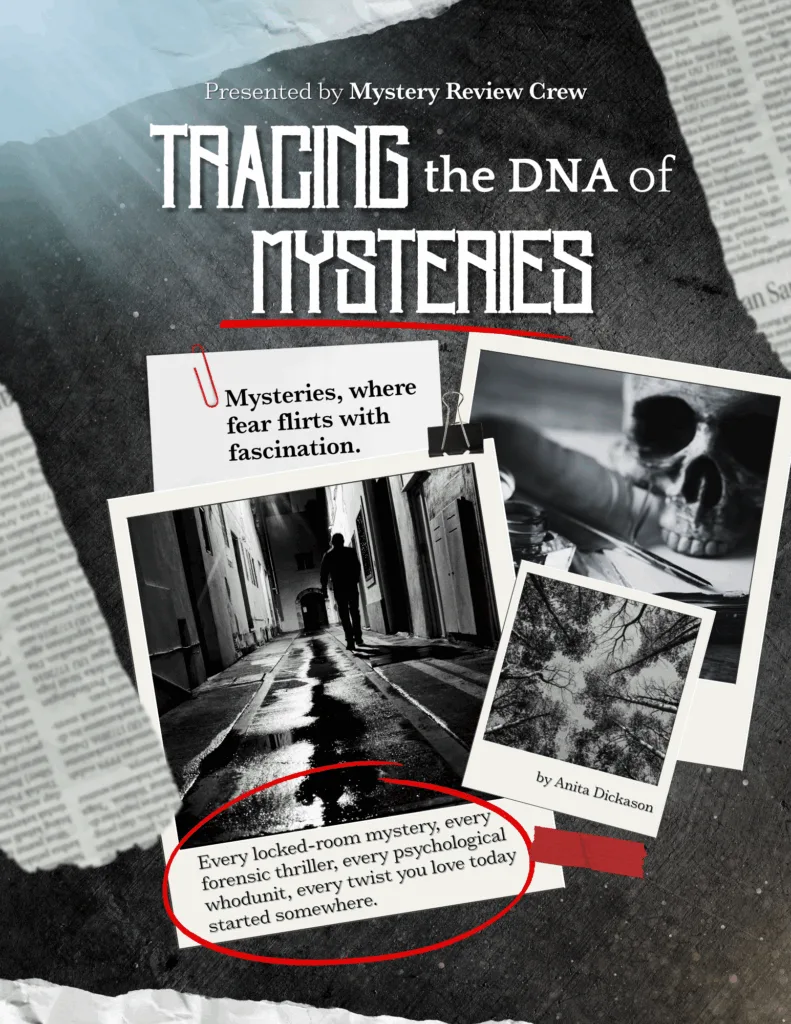
Tracing the DNA of Mysteries. Mysteries, where fear flirts with fascination. Every locked-room mystery, every forensic thriller, every psychological whodunit, every twist you love today started somewhere. For True Crime month, the Mystery Review Crew is unearthing the genre’s primal roots—where the thrill of the unknown first took hold and never let go.
The Century That Birthed the DNA of Mysteries
The 1800s, a century of contradiction. Before DNA, before Miranda rights, before the word “serial killer” entered our vocabulary, the 1800s were a crucible of crime. Beneath the lace and civility of the Victorian era, a world of deception, desperation, and violence simmered. This was a time of arsenic-laced tea, forged identities, and courtroom dramas that gripped entire cities.
The 19th century didn’t just witness crimes; it transformed them. Some cases sparked legal reforms. Others fueled public hysteria. It was an age of spectacle. Public executions still drew crowds in the early decades. Courtrooms became theaters of morality.
*Affiliate links are used in this article. The Mystery Review Crew is an Amazon Affiliate and, as such, earns from qualifying purchases. See our privacy policy and disclosures for more information.
This was the century that ushered in the modern-day detective. Scotland Yard was founded in 1829, followed by the Pinkerton National Detective Agency in 1850. With them came a new era of criminal investigation. Fingerprints, mugshots, and forensic autopsies began to surface, alongside the public’s fascination with this new science of detection.
In many ways, the 1800s were the first true crime century—where storytelling and justice collided. Newspapers became the lifeblood of public fear and fascination. With no radio or television, the broadsheets and penny dreadfuls delivered lurid tales of murder and betrayal to breakfast tables across London, New York, and San Francisco. The more sensational the crime, the more ink it earned. And the more ink it earned, the more it shaped a demand for stories that blurred the line between fact and fear.
For every Jack the Ripper or Lizzie Borden who became infamous, dozens of equally shocking cases were once shouted in courtrooms and scribbled in editorials. Now they linger as forgotten footnotes. Yet, these were the crimes that shaped laws, terrified communities, and inspired fiction.
The Penny Dreadful: Crime as Entertainment
By the mid-1800s, crime wasn’t just feared—it was consumed. The working class, newly literate and hungry for affordable entertainment, turned to serialized fiction sold for a penny. These weekly publications, known as penny dreadfuls (or penny bloods), delivered lurid tales of murder, betrayal, and supernatural horror in eight to sixteen-page installments.
They were the precursors to modern crime fiction and tabloid journalism—cheap, fast, and dripping with drama. Highwaymen, poisoners, haunted mansions, and masked villains filled their pages. Stories like Varney the Vampire and The Demon Barber of Fleet Street (yes, Sweeney Todd) blurred the line between real crime and gothic fantasy.
But they didn’t just entertain. They influenced public perception of crime, often exaggerating or fictionalizing real events. Some critics accused them of inciting violence among youth. Others, like G.K. Chesterton, defended them as moral tales disguised in melodrama: “Sensational novels are the most moral part of modern fiction,” he wrote. “For life is a fight and not a conversation”.
Their legacy? The serialized mystery. The detective hero. The cliffhanger ending. And the idea that crime—especially murder—could be both horrifying and thrilling.
Forgotten Crimes That Shaped the Genre
While the 19th century gave rise to the detective and the serialized mystery, it was the real-life crimes—often sensational, sometimes tragic—that laid the emotional and psychological groundwork for the genre. These cases didn’t just shock the public; they introduced archetypes, investigative dilemmas, and moral ambiguities that fiction would later refine. And though many have faded from popular memory, their fingerprints remain on every locked-room mystery, courtroom thriller, and psychological whodunit we read today.
The Poisoner’s Paradox: Cordelia Botkin & the Postal Murder
In 1898, Cordelia Botkin mailed a box of poisoned chocolates from California to Delaware, targeting her lover’s estranged wife. The victim died, and Botkin became the first person in American history to be convicted of murder across state lines. The case raised questions about jurisdiction, intent, and the forensic reliability of chemical testing.
But beyond its legal implications, Botkin’s crime introduced a chilling motif: the domestic killer cloaked in civility. She wasn’t a shadowy figure in an alley. She was a well-dressed woman with access to arsenic and a flair for manipulation. This archetype would echo through fiction for decades, from Agatha Christie’s genteel murderers to Gillian Flynn’s modern femme fatales.
Madness or Malice: Laura Fair & the Trial of Emotion
Laura Fair’s 1870 murder of her lover, prominent attorney Alexander Crittenden, was a media sensation. She shot him in public, claimed emotional instability, and became the center of a trial that blurred the lines between mental illness, gender expectations, and criminal responsibility.
Her defense hinged on “female hysteria”—a diagnosis steeped in Victorian bias. The jury initially sentenced her to death, but public outcry led to a retrial and eventual acquittal. Fair’s case exposed the fragility of legal objectivity and the power of public sentiment. It also laid the groundwork for the “unreliable narrator” and the morally ambiguous heroine—figures that would populate mystery fiction for generations.
The Belfry Murders: William Henry Theodore Durrant
Dubbed “The Demon of the Belfry,” Durrant was a medical student who murdered two women in a San Francisco church in 1895. The brutality of the crimes—one victim found in a closet, the other in the church’s belfry—shocked the city. His trial became a media circus, with reporters speculating on motive, madness, and the symbolism of sacred space turned sinister.
Durrant’s case introduced a potent genre tension: the respectable man with a monstrous secret. He was educated, articulate, and outwardly devout—yet capable of unspeakable violence. This duality would become a staple of psychological thrillers, where the killer hides in plain sight and the setting itself becomes complicit in the crime.
The Gentleman Swindler: George D. Collins & Legal Deceit
George D. Collins was a brilliant attorney who manipulated the legal system for personal gain—committing bigamy, forging documents, and exploiting loopholes with chilling precision. His crimes weren’t bloody, but they were deeply unsettling. He weaponized trust, intellect, and institutional power.
Collins exemplified the cerebral villain—the one who doesn’t need a knife, only a signature. His legacy lives on in courtroom dramas and legal thrillers, where the antagonist is often a master of manipulation rather than brute force. He also foreshadowed the genre’s fascination with moral ambiguity: when does cleverness become criminal?
The Double Bank Robbery: The Dalton Gang’s Final Act
In 1892, the Dalton Gang attempted to rob two banks simultaneously in Coffeyville, Kansas. It was a bold, cinematic move—one that ended in a bloody shootout and the gang’s demise. The event was widely covered, romanticized, and later fictionalized in dime novels and early Westerns.
Though often filed under outlaw lore, the Daltons’ final heist shaped the genre’s appetite for spectacle, timing, and fatal miscalculation. It introduced the idea that crime could be choreographed—and that even the most daring plan could unravel in seconds. This tension between control and chaos remains central to heist narratives and procedural thrillers.
Arsenic-Laced Tea: A Quiet Killer in the Parlor
In Victorian Britain, arsenic earned its reputation as “inheritance powder”—odorless, tasteless, and disturbingly accessible. Tea, a daily ritual, became a discreet delivery method for murder.
Madeleine Smith (1857): Accused of poisoning her lover with arsenic-laced cocoa in Glasgow. Her acquittal sparked fascination with the “respectable poisoner” archetype.
Bradford Lozenge Poisoning (1858): Though not tea-related, this mass poisoning—20 dead, 200 sickened—exposed the dangers of arsenic in everyday goods.
Arsenic’s domestic ubiquity blurred the line between accident and intent, fueling both real investigations and fictional tropes. In mystery lore, it remains the emblem of elegance turned lethal—murder served in porcelain.
The Royal British Bank Scandal, 1856
While primarily a financial fraud, the case involved forged credentials and false identities among directors to manipulate public trust and embezzle funds. It fueled public paranoia about impostors in positions of power.
The Tichborne Case, 1870: A Masterclass in Identity Theft
Arthur Orton, a butcher from Wapping, claimed to be Sir Roger Tichborne, a missing aristocrat presumed lost at sea. Despite glaring inconsistencies, Orton spoke no French, had a different build, and lacked key memories—he convinced many, including Roger’s mother, of his identity.
The case gripped Victorian England, blending class tension, media frenzy, and courtroom spectacle. Orton’s trial for perjury lasted 188 days, one of the longest in British history. He was ultimately convicted, but the public remained divided—some saw him as a folk hero challenging the elite.
The Rise of the Mystery Genre
As real-life crimes gripped the public, fiction followed suit. Edgar Allan Poe’s “The Murders in the Rue Morgue” (1841) introduced the analytical detective. Wilkie Collins’ The Moonstone (1868) layered suspense with psychological depth. And by the end of the century, Arthur Conan Doyle’s Sherlock Holmes had become a cultural icon—born from the very forensic and investigative shifts that real crimes demanded.
These stories didn’t just entertain; they mirrored the public face of crime, the fear of strangers, the fragility of identity, the possibility that evil could wear a gentleman’s or a lady’s face.
In the flicker of gaslight and the ink of broadsheets, murder, fraud, and scandal became a narrative. And between the courtroom drama and broadsheets, the mystery genre found its voice.
It was a voice shaped by real crimes and sharpened by public obsession. Who benefits? Who lies? Who watches when the lights go out? As the century turned, mystery fiction didn’t just reflect the world—it reimagined it. It gave shape to fear, language to suspicion, and a kind of justice to stories that never let go.
In the flicker of gaslight and the ink of broadsheets, murder, fraud, and scandal became a narrative. And between the courtroom drama and broadsheets, the mystery genre found its voice.
See more of our True Crime articles with our yearly month of True Crime stories in November!