For True Crime November, we’re interrogating…I mean interviewing Thriller Author Conor McAnally about his new book, Bullets In the Water. His book is set in Bastrop, Texas, with the idea for the book coming around via some real events that Conor McAnally used as inspiration.
About Conor McAnally
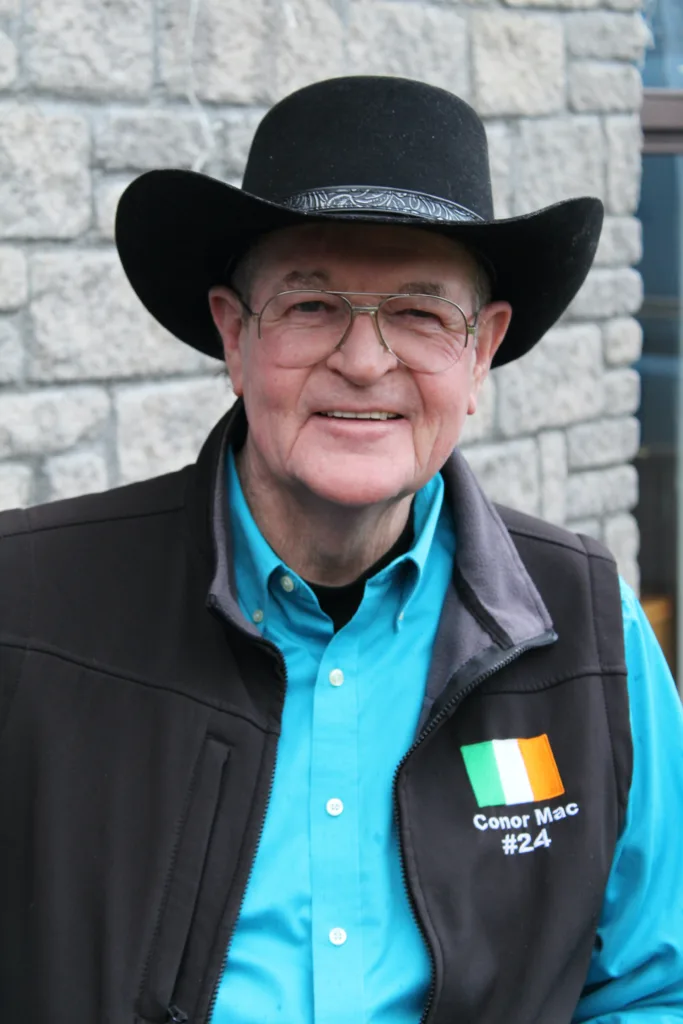
Conor McAnally is an award-winning writer, performer, producer, and TV director. A native of Ireland, he is a former investigative print, radio, and television journalist. Conor has produced thousands of factual and entertainment television shows for networks worldwide, including BBC, ITV, Channel 4, DirecTV, AMC, Nickelodeon, RTE, SBS, Fuse. His TV shows have garnered 22 major awards, including five British Academies and five from the Royal Television Society.
His story Love Spines was the 2024 winner of the Plaza Prize for Microfiction. His short stories Shattered Silence and The Bell Tolls were published in the anthology Stories of Place by Black Rose Writing in April 2025. The Psychiatrist’s Window was a prize winner in the South West Writers’ short story competition and was published. McAnally created, wrote, produced, and directed the hybrid youth drama series Over The Wall for BBC. He divides his time living in Austin, Texas, and Galway, Ireland.
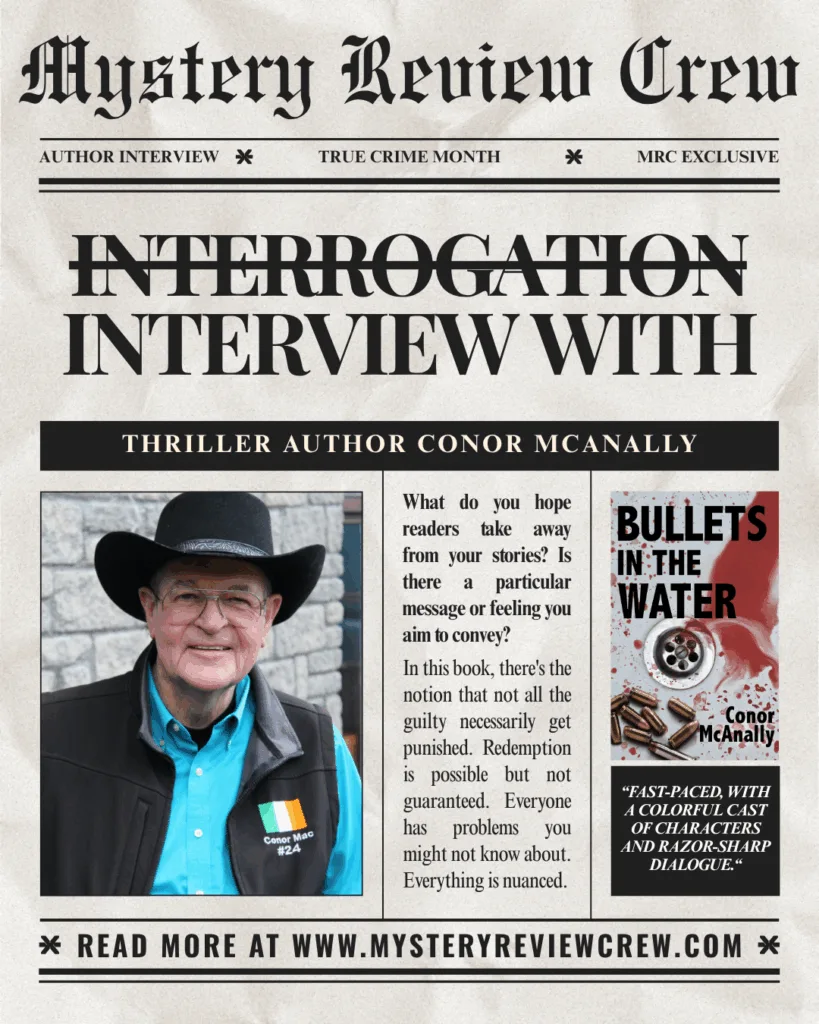
Our Interrogation… Interview with Author Conor McAnally
*Affiliate links are used in this article. The Mystery Review Crew is an Amazon Affiliate and, as such, earns from qualifying purchases. See our privacy policy and disclosures for more information.
Bullets in the Water was inspired by real murders in Bastrop, Texas. How did you balance staying true to real-life events while crafting a fictional story that still feels authentic—and safe enough for the people who might recognize themselves?
The actual murders in Bastrop were inspirations rather than anything else. The idea that someone would hire a contract killer to assassinate someone in a pristine strip mall that never opened to the public was intriguing. A person tossing newspapers into driveways in the early hours of the morning being shot dead, was also very odd and unusual. But that’s where the similarities begin and end. All the rest is fiction from my imagination. I’ve only used those unusual circumstances in the book. There is nothing to connect the real-life perpetrators or victims to the characters in the book.
You’ve gone from investigating stories for TV to crafting them on the page.
What surprised you most about trading the camera lens for a writer’s notebook?
The biggest difference, I suppose, is that you can sculpt and craft the situations to suit your plot. You are not stuck with the facts as you would be in a documentary. You can make your characters do and say what you want. You’re not stuck with what they’ve told you that’s inconvenient to your storyline, as you sometimes are in real-life documentaries. But the lens is always present in my writing. I “see” every scene, every interaction, every landscape, building, or situation as if I were watching it through a camera lens.
Mike Carson is a disgraced journalist who can’t quite leave the chase behind. How much of your own journalistic DNA found its way into him—and did you give him any traits you wish you had when you were reporting?
I think Mike’s doggedness is a trait I had myself as a reporter. What I wish I’d had in real life was Mike’s determination to live the story in the ways that he did. I wouldn’t have lived on the streets for two weeks for a story. And I’d have loved a Pulitzer but never got one!
With 22 major awards and a global TV career, you’ve seen the world from the inside of many control rooms. What does storytelling on paper let you say that broadcast television never could?
The biggest difference is that you can tell the story the way you want it to play out. You are not bound by broadcast laws or norms. When I write on paper, I can take the “camera” (the viewer/reader) anywhere I want to. I can eavesdrop on the bad guys, be present in situations you’d never be able to place a camera in real life. And you can do it in any order that makes sense to me.
The title Bullets in the Water is both poetic and ominous. What’s the story behind that name—and how does it reflect the themes of corruption and cover-up in the novel?
The real issue in the book is the concept that water is the new oil. Its scarcity makes it hugely valuable. Sometimes in life, people become so greedy in their pursuit of money that they are prepared to resort to violence, even murder, to achieve their ends. The water reference is tap water, but bloody deeds have been done in order to get it to the customer.
From Galway to Austin, you’ve lived in two very distinct storytelling cultures. Do you find Irish storytelling humor sneaking into your Texas thrillers—or does Texas draw out a grittier kind of truth?
Galway and Texas have two great storytelling traditions, and I love both very much. I think the grittier Texas truth is in the action, and some of that Irish humor has, hopefully, found its way into the dialogue, particularly the interactions between Mike and his friend Frank Wolfe and between Mike and Sam Washington. We have a thing in Ireland called ‘slagging’. In America, you’d call it ‘ribbing’ or something similar. It’s the art of gentle insults between friends, but done with love. I think it spices up the dialogue and helps establish the kind of relationships involved.
Your background spans newsrooms, film sets, and now fiction. If Bullets in the Water were adapted for the screen, would you rather direct, write the screenplay, or sit back and watch someone else interpret it?
I have thought about this a bit and concluded that what I would really like is to be part of the writing team, but not the main screenwriter. Writing short stories and novels is different from screenwriting. They are two very different disciplines. I wouldn’t presume to have the skills of a screenwriter, but I’d like to learn them.
In a screenplay, you simply can’t have the same complexity as a novel, and the screenwriter has to be tough in the decision-making process of what is essential to the story and what can be ignored. When I wrote and directed a piece, I never edited it. I always hired an editor. Those fresh eyes on the material make a huge difference. I’ve often had shots tossed in the bin that cost a lot of money and time, but the editor just said they did not work. The editor is not emotionally attached to the production of the material. All the editor cares about is using the available material to best suit the story being told.
Every good journalist has a “one that got away”—a story they couldn’t publish. Did any of those old, unfinished investigations influence the secrets you buried in this novel?
The big one that got away from me in real life was Britain’s MI6 (military intelligence) involvement in the planting of bombs by Ulster Unionists in Dublin. My colleague and I were very close to getting enough evidence to print when my death notice was phoned to the newspaper. It said I’d died “following an accident”. The editor felt it was getting too dangerous and decided to pull us from the investigation. In the book, I’ve just made references to Mike having some busts — investigations that didn’t pan out and cost his employer a lot of money.
That pressure and his alcoholism resulted in him cutting some corners and ultimately losing his job. Fortunately, I don’t have a problem with alcohol, but I know a lot of people, including family members, who have, and that gave me an insight into that addictive world.
And finally, a lighter note—because every mystery needs a breather. If you could share a pint with any of your characters, who would it be—and what uncomfortable truth would probably come out halfway through?
I love Sam Washington, the State Investigator. He’d be great to have a pint with (although he’s sober in the book) because he would be full of fascinating stories. The uncomfortable truth that would come out after the fourth or fifth pint would be that neither of us was as good at our jobs as people might think. We’d both been lucky.
Can you share your journey to becoming an author? What inspired you to pursue a writing career?
When I was leaving high school, my dad asked what I wanted to do with my life. “I want to be a writer”, I said. “You’ll never make any money doing that,” he said. “If you want to write for a living, you need to go into journalism or advertising.” I didn’t want to write adverts, so I opted for journalism instead.
Over the years, I wrote some short stories and started novels, but they all sat in drawers turning yellow over the years. Journalism took me through newspapers, into radio and television, into program presenting, and then into producing and directing. But as I wound down my television career, I turned back to my first love, the thing I had wanted to do all along.
Did you always know you wanted to be a writer, or did your passion for storytelling develop over time?
I started writing as a teen. I began with poetry and prose poetry. But I guess the passion for storytelling was always there. I don’t want to sound boastful, but I can tell a great yarn, at least that’s what people say. And I love doing it. I’ve been very fortunate that my life has taken me into great places where unusual things have happened that make great stories to tell in a pub or over dinner.
Like the time a Disney executive told me that Mickey Mouse was not a mouse, or a stand up and drag out with all six foot six of a famous rapper who wasn’t coming to rehearsal on time, or the time our vision mixing desk locked on a shot from remote studio where a man was engrossed in picking his nose instead of a shot of Jim Diamond in our studio singing “Remember I Love You.”
What was the first story or piece of writing you remember creating? How has your writing evolved since then?
It was a poem. First verse ran
I look across the expanse of Dublin Bay
Where a line of orange lights so gay
Beckon us into the neon city
Where concerned bankers mumble their pity
At devaluation
I think that my writing has become more sparse, terse, more action-based, and more direct. It has been fed by all the experiences I’ve had in life, the triumphs and tragedies, the familial upheavals, the business successes and problems, and betrayals by people I trusted. I’ve been living a rich life full of adventure, and all of that feeds into the storytelling.
Are there any specific authors or books that influenced you early in your writing journey?
So many. I was a big Jack Higgins fan, Elmore Leonard, Frederick Forsyth, Wilbur Smith, James Clavell, and John LeCarré. At one point in my career, I was producing a show about popular fiction called The Write Stuff, and we interviewed Jack Higgins at his home in Jersey. After the pre-interview, I heaved a suitcase up onto his coffee table and asked him if he wouldn’t mind signing the 26 books inside. The look on the poor man’s face was priceless.
How do you approach the process of generating new ideas and translating them into fully-fledged stories?
I’m a ripped-from-the-headlines kind of guy. I see something that actually happened and figure out how I can build a different story around it, something a bit more offbeat and maybe a bit more fanciful and dramatic.
What challenges did you face when you first started writing, and how did you overcome them?
The biggest issue I had was imposter syndrome. Who the heck was I to think I could do this? None of the success I’d had in different areas meant anything when I approached the blank page. So there were a lot of days where I was asking myself, “Who the hell do you think you are? Why would anyone want to read what you write?” I just had to grit my teeth and write, and then think it could always go into a drawer and never see the light of day. But I was encouraged greatly by joining a writing group and getting feedback.
I think in the early stages of a writing career, it is a terrific thing to be part of a writing group that gives considered, positive feedback. I’m lucky enough to be part of a couple of great groups where you can try out your new material. I also attended a course run by a lady called Erin Hallagan Clare, who has an operation called The Story Parlor. She used to be in Austin, but now she is in North Carolina. She connects people with their creativity. I owe her a lot.
Can you describe your typical writing routine? Do you have any specific habits or rituals that aid your creative process?
One of the things that really works for me in a Pavlov’s dog kind of way is music. I compiled a playlist of about 6 hours of instrumental music, starting with the soundtrack of The Last of the Mohicans. Once I hear the first strains of that, I know I have to write.
Are you a planner or a “pantser” (writing by the seat of your pants)? How do you approach structuring your stories?
I’m more of a planner than a pantser, although it depends sometimes. I did a short story last year that simply started with this: “I stand in shattered silence.” I had no idea where that might go. In the end, it turned out to be a story about a special forces soldier on a journey of revenge against Islamic terrorists who killed his mates in a bomb blast. But mostly I need to know how the plot is playing out. I still get surprised when characters twist away from the path, but that’s the fun of writing.
How do you develop and bring your characters to life? Are they ever inspired by real people or experiences?
All the characters are people I can imagine and are usually compilations of people I’ve met in real life. A personality here, a physical description there, a speech tick from somewhere else. And the internal back stories of characters are very much informed by my own experiences and those of folk I know. I think that brings a great deal of authenticity to the writing.
What role does research play in your writing? How do you strike a balance between authenticity and creative freedom?
I think research is a crucial part of writing, but you shouldn’t be a slave to it. The key is not to take the reader out of the story. Getting details wrong will annoy people, and you’ve lost them in that moment. Your credibility as a storyteller is in question at that point in the mind of that reader. So, I do try to make sure that everything is possible, the details are correct, and that nothing will take the reader out of the story.
Do you have a favorite genre or style to write in, or do you enjoy experimenting with different forms of storytelling?
My favorite is thriller writing. But I also write a lot of poetry, short stories, flash fiction, and microfiction. I also write spoken word. It’s fun to play with form. Last year, I wrote two thriller short stories in a spoken word type of format, which were published earlier this year in an anthology called Stories of Place by Black Rose Writing.
People would ask me, “I noticed that there’s a lot of rhyme in those stories. Was that deliberate?” Yep. It was. And it wasn’t easy. It was kind of weird to have rhyme and rhythm in a piece about assassinations and a contract killer.
What sources of inspiration do you draw upon when crafting your stories? Are there particular life experiences that influence your writing?
All of my life experiences find their way into the writing in one form or another. Bullets In The Water has a few car chases, for example, and I was able to write about that because I raced sports cars for six years.
Are there specific themes or recurring motifs that you find yourself exploring in your writing?
The most important thing to me is truth. Truth and facts, and the importance of them. In a world where “truth” is being personalised and siloed, it’s important to me to emphasize that there are objective truths based on verifiable facts. Redemption is also a theme I like. We are all capable of reforming ourselves and coming back from the darker parts of our nature.
Do you have a favorite character that you’ve created? What makes this character particularly special to you?
With Bullets In The Water, my favorites obviously include Mike Carson, the protagonist (although he’s a bit more flawed than I’d like). I love Sam Washington, the good-looking State investigator who’s smart and has a real way with words. But I weirdly liked Sonny Bell, the contract killer, so much that I wrote a short story about him later on because I was wondering what happened to him after the book was over.
How do you approach writing dialogue to make it feel authentic and engaging for readers?
I’ve had to be good at writing dialogue because of my jobs in television and radio. I’ve written for the spoken word in all my scripts for shows. But the key thing for me is to differentiate between the voices, give people little idiosyncratic vocal tics, and always, always, always read dialogue out loud to make sure it sounds right.
Can you share a memorable interaction or dynamic between two of your characters that you particularly enjoyed writing?
I always liked the interactions between Mike and his friend Frank Wolfe. The gentle piss-taking is fun to write.
“And Ron Knowles couldn’t protect you?” Frank asked.
“Nothing he could do. He only had a week left before he went to the LA Times. Editor no less.”
“I heard. Damn. But, Mike, you know…”
“Yeah, I know. What else could they do?”
“Where are you staying?”
“I’m movin’ into Uncle Harold’s place.”
“Is it even habitable?”
“Barely, but I’m doing some renovations before I sell it.”
Frank chuckled.
“Using what? Your legendary DIY skills? Seriously, though…and I am serious, you need to get help, not for the house—well, for that too. You’re too good for this shit. Not sure Texas is the right place for you. You know, the boredom.”
“Not that boring. We just had a murder.”
“Just the one?”
There was a pause and Frank chuckled again.
“Now I’m thinking this is your worst screw-up since Helmand.”
“Don’t remind me,” Mike laughed.
“I mean, who runs at two Taliban machine gunners waving tidy whiteys and screaming ‘PRESS’ at the top of their voice?”
“It worked, didn’t it? We got out.”
“That we did, that we did. Look, I don’t know what I can do from here, but if you need anything just hit ‘dial,’ OK? How are you for cash?”
“Thanks, Frank. No. I’m fine. I had some for a rainy day.”
“Let me ask you this question, then. Is it pissing down enough for you to get your shit together?”
“I’ll let you know.”
“Take care of yourself, Skippy. Don’t want to lose you.”
What do you hope readers take away from your stories? Is there a particular message or feeling you aim to convey?
In this book, there’s the notion that not all the guilty necessarily get punished. Redemption is possible but not guaranteed. Everyone has problems you might not know about. Everything is nuanced.
Thanks so much for taking the time to let me interview you, Conor McAnally! I enjoyed learning more about you, and you have some great perspectives. I look forward to reading Bullets in the Water!
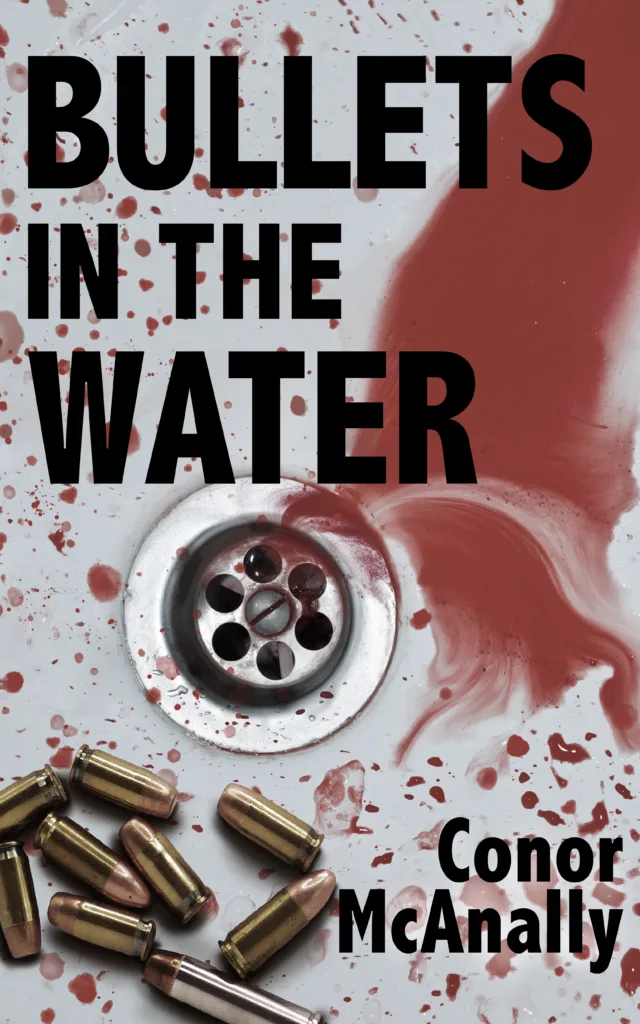
Check out Conor McAnally’s Latest Release: Bullets in the Water
Author: Conor McAnally
Genre: Mystery, Investigative Thriller, Thriller
A gripping tale of small-town intrigue and corruption, inspired by real murders that occurred in Bastrop, Texas, while the author was living there.
When Mike Carson, a disgraced New York journalist, returns to his Texas hometown to sell his late uncle’s house, what should be a simple task quickly spirals out of control. Asked to investigate a suspicious death, Carson uncovers a web of lies, self-dealing, and drug trafficking, and with each revelation, he finds himself dragged deeper into a powerful conspiracy.
Fast-paced, with a colorful cast of characters and razor-sharp dialogue, Bullets in the Water is a must-read for fans of crime fiction and investigative thrillers.
On Goodreads, Amazon, B&N, Stoney Creek Publishing, and Bookbub.